

购物车
 您的购物车当前为空

 很棒
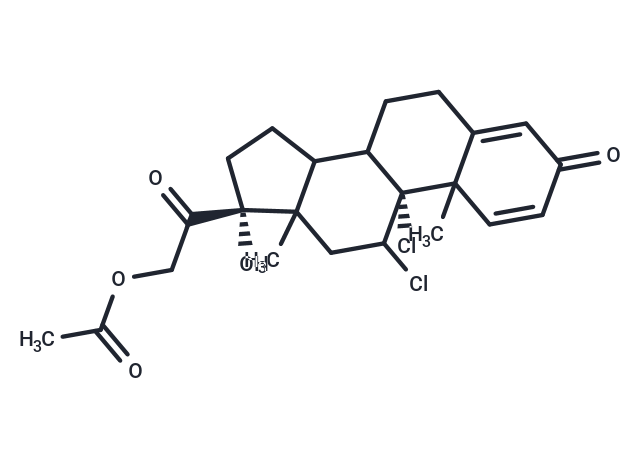
很棒Dichlorisone Acetate (Diloderm) 一种是合成的糖皮质激素皮质类固醇,具有抗炎特性。
很棒纯度: 99.51%
别名 糊状叶绿素, 醋酸二氯松, Diloderm
Dichlorisone Acetate (Diloderm) 一种是合成的糖皮质激素皮质类固醇,具有抗炎特性。
为众多的药物研发团队赋能,
让新药发现更简单!
| 规格 | 价格 | 库存 | 数量 |
|---|---|---|---|
| 1 mg | ¥ 186 | 现货 | |
| 5 mg | ¥ 413 | 现货 | |
| 10 mg | ¥ 662 | 现货 | |
| 25 mg | ¥ 1,090 | 现货 | |
| 50 mg | ¥ 1,650 | 待询 | |
| 100 mg | ¥ 2,460 | 待询 |

| 产品描述 | Dichlorisone Acetate (Diloderm) is a synthetic glucocorticoid corticosteroid with anti-inflammatory activity. |
| 别名 | 糊状叶绿素, 醋酸二氯松, Diloderm |
| 分子量 | 455.37 |
| 分子式 | C23H28Cl2O5 |
| CAS No. | 79-61-8 |
| Smiles | CC(=O)OCC(=O)[C@@]1(O)CCC2C3CCC4=CC(=O)C=CC4(C)[C@@]3(Cl)C(Cl)CC12C |
| 密度 | 1.34g/cm3 |
| 存储 | |||||||||||||||||||||
| 溶解度信息 | DMSO: 4.56 mg/mL (10.01 mM), Sonication is recommended.  | ||||||||||||||||||||
溶液配制表 | |||||||||||||||||||||
DMSO
该溶液配制表仅适用于固体产品。对于液体产品,请根据标明的浓度或密度计算稀释方案。 | |||||||||||||||||||||
对于不同动物的给药剂量换算,您也可以参考 更多

 嗨!有任何问题?点我咨询

版权所有©2015-2026 TargetMol Chemicals Inc.保留所有权利.
沪ICP备20019793号-4 | 沪公网安备 31010602006700号 | 沪(静)应急管危经许[2024]203441